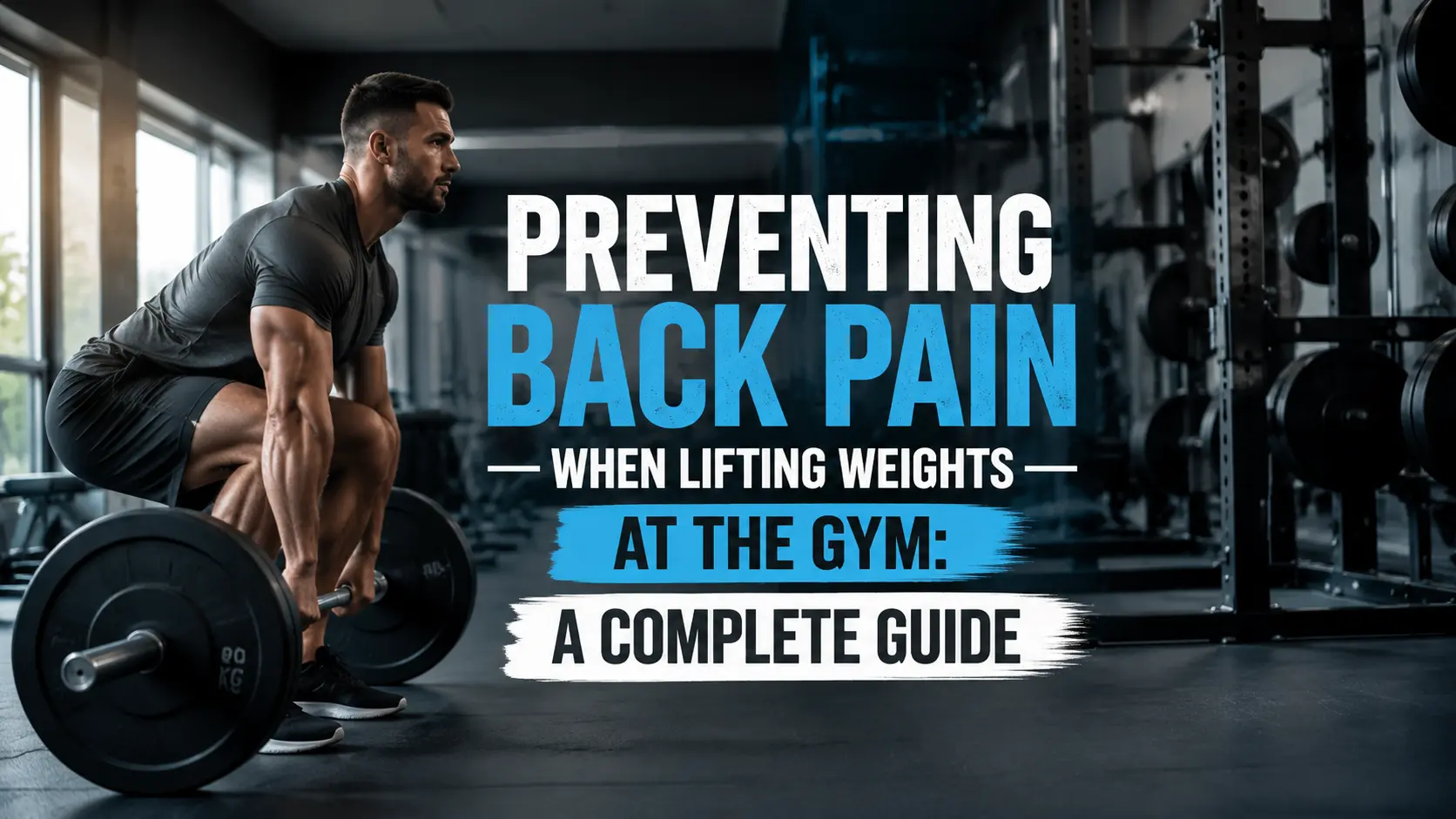
You finally got consistent with your gym routine. Deadlifts, squats, rows — you’re putting in the work. But then your lower back starts talking back, and not in a good way. Sound familiar?
Back pain from lifting weights is one of the most common complaints among gym-goers across the United States. According to published research, the lower back accounts for 23% to 59% of all reported injuries among weightlifting athletes — making it the most commonly injured region in the sport. But here’s the thing: most of those injuries are entirely preventable.
Whether you’re a seasoned lifter or just starting out, this guide breaks down exactly what causes gym-related back pain, how to prevent it with smart training habits, and when it’s time to stop guessing and see a professional. Because the goal isn’t just to lift heavy — it’s to lift for life.
Why Your Lower Back Is So Vulnerable at the Gym
Your lumbar spine — the five vertebrae in your lower back — does an enormous amount of work every single day. It supports your upper body weight, stabilizes your posture, and transfers force between your upper and lower body during virtually every lifting movement. That means every squat, deadlift, bent-over row, and Romanian deadlift is loading the lumbar spine to some degree.
When that load is applied with poor mechanics, rushed tempo, or a fatigued body, things go wrong. The most common culprits include:
Poor Lifting Technique — Rounding the lower back under load, jerking weights, or twisting while holding a barbell creates shear forces that the spinal ligaments and discs aren’t designed to absorb repeatedly. Over time, this causes micro-tears, inflammation, and eventually significant pain. BSW Health research confirms poor form is the single most common cause of fitness-related lower back pain.
A Weak Core — Think of your core as a natural weightlifting belt. When it’s strong, it distributes load evenly across the spine and abdomen. When it’s weak, the lumbar vertebrae and surrounding muscles take on all the stress — which is a recipe for strain, herniation, or chronic aching.
Tight Hip Flexors and Hamstrings — When these muscles are tight, they tilt the pelvis out of its neutral position, forcing the lower back to compensate during lifts. Over time, this imbalance leads to cumulative stress on the spinal joints and discs — conditions that specialists at a Top Back Pain Clinic in Chicago see on a daily basis.
Doing Too Much, Too Soon — Progressive overload is a legitimate training principle, but aggressively stacking weight before your technique is dialed in is one of the fastest paths to injury. Muscles adapt more quickly than tendons and ligaments, which means your strength can outpace your structural readiness.
Skipping the Warm-Up — Cold muscles are stiff muscles. Lifting without a proper warm-up dramatically reduces your joint flexibility and neuromuscular coordination — both of which are essential for maintaining proper spinal alignment under load.
The Most Dangerous Gym Movements for Your Back (And How to Do Them Right)
Deadlifts and Romanian Deadlifts
The conventional deadlift is one of the most effective posterior chain exercises in existence. It’s also one of the most commonly butchered. Rounding the lower back at the bottom of the pull, jerking the bar off the floor, or letting the hips shoot up before the chest — each of these errors creates significant spinal flexion under compressive load.
The fix: Hinge at the hips, not the waist. Keep your chest tall, shoulders slightly in front of the bar at setup, and maintain a neutral spine throughout the entire movement. Brace your core as if you’re about to take a punch before every rep. According to Spine-health, using controlled, slow movements with eccentric and concentric control — rather than explosive or jerky technique — significantly reduces the injury risk associated with heavy pulling movements.
Squats
The squat is notorious for exposing hip mobility limitations. If your hip flexors are tight or your ankle dorsiflexion is limited, the spine will compensate — often through excessive forward lean or “butt wink” at the bottom of the squat. Both patterns dump load onto the lumbar discs in compromised positions.
The fix: Work on hip and ankle mobility before adding weight. Use the technique recommended by Orthopedic Institute experts: place feet shoulder-width apart, initiate the movement by pushing the hips back and down, keep your chest elevated, and maintain all three points of spinal contact — head, mid-back, and sacrum — throughout the descent and ascent.
Bent-Over Rows and Good Mornings
These exercises require sustaining a hip-hinged position under load for multiple reps. If the lower back rounds or fatigues mid-set, the lumbar spine takes on shear stress it wasn’t designed to handle.
The fix: Lighten the load until your hip hinge is mechanically sound. Engage your lats before pulling to protect the shoulder girdle and reduce strain at the thoracolumbar junction. Rest between sets — don’t rush through fatigue.
A Proven Prevention Strategy: 7 Habits That Protect Your Back at the Gym
1. Always Warm Up Dynamically
A warm-up doesn’t mean five minutes on the treadmill at conversation pace. For lifters, dynamic warm-up means activating the exact muscle groups you’re about to use. Hip circles, leg swings, cat-cow movements, glute bridges, and band pull-aparts prime your posterior chain and increase synovial fluid in the joint spaces. Mercy Health physical therapists emphasize that dynamic mobility work before lifting is one of the most underused tools for lower back protection.
2. Master the Hip Hinge Before You Load It
The hip hinge is the foundation of nearly every lower body pulling movement. Most gym-goers skip the fundamentals and go straight to loaded barbells — a mistake that directly contributes to lumbar strain. Practice the bodyweight hinge until the pattern is automatic. A simple drill: stand with feet shoulder-width apart, soft knees, and push your hips backward as if reaching for a wall behind you. Your torso drops forward while your spine stays neutral. That’s the movement. Only then should you add weight.
3. Build a Spine-Protecting Core — Not Just a Six-Pack
Crunches don’t build the kind of core that protects your lumbar spine under load. What you need is anti-rotation, anti-flexion, and anti-extension stability. The following exercises build exactly that:
- Planks — Hold for 30 to 60 seconds, focusing on a rigid, neutral body position. Don’t let the hips sag.
- Bird Dog — Extend opposite arm and leg simultaneously while keeping the spine completely still. Ten reps per side.
- Dead Bug — Lie on your back, arms extended to the ceiling, hips at 90 degrees. Lower opposite arm and leg toward the floor slowly without allowing your lower back to arch off the ground.
- Hip Extension / Glute Bridge — Lie on your back with knees bent. Drive your heels into the floor and raise your hips to form a straight line from knees to shoulders. This activates the glutes and reduces the demand on lumbar extensors.
- Superman Hold — Lie face down and raise both arms and legs simultaneously. Hold for ten seconds. This strengthens the erector spinae and glutes without compression.
4. Engage Your Core Before Every Single Rep
This is non-negotiable. Before your hands touch the bar, take a deep breath and brace your abdominals — a technique called the Valsalva maneuver or intra-abdominal pressure bracing. This creates a rigid cylinder of support around your lumbar spine that dramatically reduces disc compression forces during lifts. Think of it as inflating a balloon in your abdomen before loading the bar.
5. Progress Gradually and Respect Your Body’s Signals
Ego lifting is the fastest route to a long rehabilitation stint. Research consistently shows that increasing load progressively — no more than 5% to 10% per week on any major lift — allows your connective tissue time to adapt. If your form breaks down, that’s your body telling you the weight is too heavy. Reduce it without hesitation. Persistent soreness, sharp pain during a lift, or pain that radiates into the glutes or legs are signals that should never be pushed through.
6. Incorporate Smart Stretching After Training
Post-workout stretching matters just as much as pre-workout activation. Focus on:
- Piriformis stretch — Relieves tension that can compress the sciatic nerve
- Psoas/hip flexor stretch — Reduces anterior pelvic tilt that strains the lumbar spine
- Hamstring stretch — Tight hamstrings pull on the sit bones and increase tension on the lumbar fascia
- Child’s pose — Gently decompresses the lumbar vertebrae and lengthens the erectors
Consistency is key. Stretching after every session significantly reduces the cumulative muscle tightness that, over time, distorts your movement mechanics.
7. Allow Adequate Recovery Between Sessions
Your muscles grow during rest, not during training. The lumbar region is no exception. Training back-heavy compound movements daily without adequate recovery is a leading contributor to overuse injuries in the gym. Schedule at least 48 hours of recovery between sessions that heavily load the posterior chain. On rest days, light walking, swimming, or yoga keeps blood flowing to spinal structures without adding stress to them.
Red Flags: When Back Pain Is More Than Just Muscle Soreness
Mild delayed-onset muscle soreness after a tough training session is normal. These symptoms are not:
- Pain that lasts longer than one week without improvement
- Sharp or shooting pain that radiates from the lower back into the buttock, thigh, or foot
- Numbness, tingling, or weakness in the legs
- Pain that worsens with rest rather than improving
- Back pain accompanied by bladder or bowel changes
These symptoms may indicate disc herniation, sciatica, spinal stenosis, or nerve root compression — conditions that require professional evaluation, not more training. When in doubt, consult a back specialist doctor who can properly diagnose what’s happening and prevent a manageable issue from becoming a chronic condition.
What Happens If You Ignore Gym-Related Back Pain?
Many lifters make the mistake of training through pain, assuming it will resolve on its own. Sometimes it does. Often it doesn’t. Untreated muscle strain can progress to ligament damage. Undiagnosed disc irritation can evolve into a full herniation with nerve compression. What begins as mild soreness after deadlifts can, over months of neglect, become the kind of chronic low back pain that disrupts sleep, limits mobility, and forces extended time away from training.
The smarter move is early intervention. The sooner a skilled clinician identifies the root cause of your pain, the simpler — and more affordable — the solution. If you’ve been searching for back pain treatment near me after struggling with persistent gym-related discomfort, the answer isn’t more foam rolling. It’s a proper clinical evaluation by a board-certified specialist.
How Chicago Sports & Spine Helps Active Patients Recover and Return to Training
Chicago Sports & Spine, led by Dr. Baljinder Bathla, M.D. — a physician dual-boarded in Physical Medicine, Rehabilitation, and Pain Management — understands that active patients have unique needs. You don’t just want to get out of pain. You want to get back under the bar.
The clinic takes a multi-disciplinary, non-surgical-first approach that addresses the underlying cause of back pain — not just the symptoms. From the very first consultation, your full history is reviewed, your movement patterns are assessed, and a customized treatment plan is built around your specific condition and fitness goals.
The clinic’s four-step patient journey — Consultation → Diagnosis → Treatment → Follow-Up Care — ensures nothing is guessed at and nothing is rushed. Services include interventional procedures like epidural steroid injections and nerve blocks, acupuncture, naprapathy, physical medicine, trigger point injections, and spinal decompression — all delivered with precision targeting the actual source of pain.
Finding the best treatment for back pain doesn’t mean choosing the most aggressive option. It means choosing a clinic that exhausts every conservative, non-surgical avenue before recommending anything more invasive. That’s precisely what the team at Chicago Sports & Spine does — and it’s why their patients come back not just recovered, but performing better than before.
As a recognized Top Back Pain Clinic in Chicago, Chicago Sports & Spine brings more than 15 years of experience treating complex spine, sports, and chronic pain conditions at their South Loop location at 1550 S Indiana Ave, Suite 100, Chicago, IL 60605.
Frequently Asked Questions
1: How do I know if my back pain from lifting is serious?
Mild soreness after a heavy training session is generally normal and resolves within 48 to 72 hours with rest and mobility work. However, if your pain is sharp, shooting, or radiates from the lower back into your legs, or if it persists beyond a week, these are signs that something more serious may be going on — such as a herniated disc or nerve compression. In those cases, it’s important to stop training and consult a qualified spine specialist for a proper evaluation. A Top Back Pain Clinic in Chicago will assess your mobility, nerve function, and medical history before recommending any course of care.
2: Can I keep lifting weights if I already have lower back pain?
It depends entirely on the nature and severity of your condition. Some types of back pain — such as general muscle tension or mild lumbar strain — respond well to continued light movement and properly modified training. Other conditions, like active disc herniation or spinal stenosis, may be aggravated by certain exercises and require medical clearance before you return to loading the spine. Never self-diagnose. See a board-certified specialist first, receive a proper diagnosis, and work within the parameters of a personalized recovery plan. The professionals at a Top Back Pain Clinic in Chicago can help you understand exactly what your spine can and cannot safely tolerate during recovery.
3: What gym exercises are safest for people with a history of back pain?
People with a history of lower back pain generally do well with exercises that strengthen the core and posterior chain without placing excessive compressive or shear force on the lumbar spine. Safe starting points include planks, glute bridges, bird dog, dead bugs, and cable pull-throughs. Walking and low-impact cardio also promote spinal circulation and reduce stiffness. Spine-health research shows that properly supervised, progressive weight training can actually relieve chronic back pain over time — the key is supervision, progression, and technique precision.
4: How long does it take to recover from gym-related lower back pain?
Recovery timelines vary depending on what caused the pain. Mild muscle strains typically resolve within two to four weeks with appropriate rest, ice, heat, and gentle movement. More significant issues like disc irritation, nerve involvement, or structural problems may take several months to fully resolve — especially if left untreated for a long period. Early intervention is the most important factor in shortening recovery time. If home management hasn’t improved your pain within seven to ten days, it’s time to seek a clinical evaluation. The sooner you get an accurate diagnosis, the sooner you can get back to training safely.
Conclusion
Lifting weights is one of the most powerful things you can do for your long-term health — but only when your spine can support the effort. The strategies in this guide — from mastering the hip hinge and building anti-rotation core strength to warming up properly and listening to your body — give you a real, evidence-based framework for training hard without paying for it later with chronic pain.
But when prevention strategies aren’t enough, and pain is getting in the way of the life and training you love, don’t wait it out. You deserve expert care from professionals who understand both your body and your goals.
If you’re dealing with persistent back pain, don’t let it sideline you any longer. Visit Top Back Pain Clinic in Chicago — Chicago Sports & Spine — and take your first step toward a pain-free, performance-ready back. Dr. Bathla and his team are ready to listen, diagnose, and build a customized plan that gets you back to doing what you love. Call (312) 623-7246 or visit their South Loop clinic at 1550 S Indiana Ave, Suite 100, Chicago, IL 60605.
Your spine powers your performance. Protect it with the best.